
Original Film
Original Film
Original Film
Role
Role
Role
Creator
Creator
Creator
Duration
Duration
Duration
Aug 2024 - May 2025
Aug 2024 - May 2025
Aug 2024 - May 2025
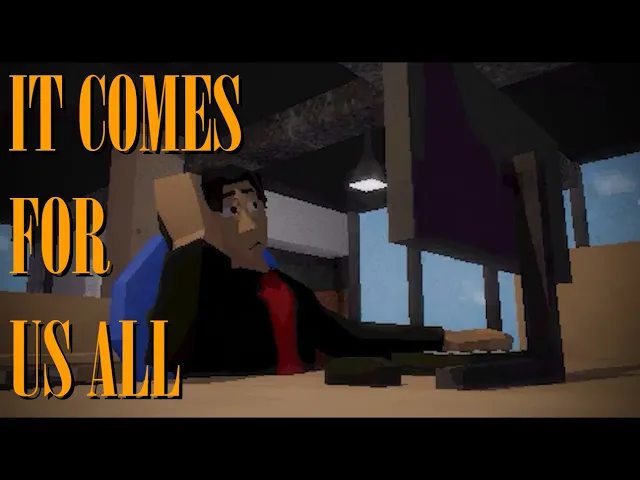
A story about time, death, depression and the inevitable. You follow Ryan, a burnt out software engineer who's world continues to fall apart. What can he do when he's faced with something he can't stop? Is there even anything he CAN do?
A story about time, death, depression and the inevitable. You follow Ryan, a burnt out software engineer who's world continues to fall apart. What can he do when he's faced with something he can't stop? Is there even anything he CAN do?
A story about time, death, depression and the inevitable. You follow Ryan, a burnt out software engineer who's world continues to fall apart. What can he do when he's faced with something he can't stop? Is there even anything he CAN do?
Before reading the breakdown, Please watch the film!
Before reading the breakdown, Please watch the film!
Let's REWIND
Let's REWIND
August 2024: during summer break
I had a thought…
August 2024: during summer break
I had a thought…
August 2024: during summer break
I had a thought…

I felt ambitious, I wanted to make something BIG
I felt ambitious, I wanted to make something BIG
I felt ambitious, I wanted to make something BIG
something…
challenging
something…
challenging
something…
challenging
I wanted to make…
I wanted to make…
I wanted to make…
a film.
a film.
a film.
My Inspiration
My Inspiration
My Inspiration

This project was born from pain.
My own pain dealing with depression.
The same pain I kept hidden for so long,
because I thought such things was too embarrassing to share.
And somehow this pain managed to crawl out of my own deepest darkest vaults and became something that ultimately saved me.
For a long time, I thought myself to be a mess,
a mess that no one wanted to talk to,
someone who wasn't good enough,
someone who's a disappointment.
I began to resent the stuff I've made, the projects I've done, the work I did. A growing rot was festering inside my soul and I felt powerless.
I really was struggling.
I got therapy but it wasn't much help, so I went soul searching instead.
I needed to think deep about what I am, who I am, and who I needed to be.
I dug deep about my own experiences with depression,
who I was, thought about my role in the universe,
got existential about concepts like death, time, and inevitability.
In my head, my chain of thought started with "death is going to take everyone eventually" to "well eventually means time, and you cant stop time" to "that means eventual death = something you can never change or stop".
Slowly, the little seed I watered in my head started growing into something real, something I could do. No longer was I pushing projects away, I was committed. I knew I had to make this project a reality, because if I didn't I would never change as a person, let alone heal.
I took that seed, and it became a lemon tree. Lemons that I later used to turn into lemonade to share with others.
as for how I came up with the name "It comes for us all",
I wanted a ambiguous name, something that sounded cool, so I came up with it on the spot, based on what I wrote.
I did have other names but I never wrote the other ones because this one really stuck out the most.
This was all on a random Saturday while I was enjoying my summer break at Widener of 2024. 😊


The Concept
The Concept
I want to make a short film with a story about a 26 year old adult man working in the computer science field. He makes good money but feels drained by the time he comes hone.
He lost his mother in a car accident 8 years back and is now losing his father due to cancer. He has 2 caring sisters that cares dearly for his well being. He used to drink every so often but started drinking everyday. He starts to skip work and doesn't answer phone calls. He distances himself as a method of coping, and begins thinking of taking his own life.
A couple weeks pass in self isolation and he begins hallucinating his parents. His sisters call him repeatedly but he doesn't pick up. then decides to give him a visit. They arrive at his apartment door and notice the door is not locked. They go around his apartment and it looks like a mess. They notice he's at his balcony, sensing that something bad is about to happen.
They slowly approach him to close the distance. Right before he goes over the balcony railing, they catch him and pull him to the ground. He cries and his sisters begin to cry too. They begin to hug.
After I had written the concept, a wave of positivity flowed out of me.
Ideas I haven't had since I was a kid/teenager started coming back.
Ideas were everywhere.
Vivid visions of how I wanted the film to look,
how each scene played out,
what my inspiration was.
It felt refreshing.
I felt like a kid again. Creating things purely out of passion.

so when did I start?
I didn't

'I don't know how to make a film.'
'I don't know how to make a film.'

I was hesitant,
I was scared about my own abilities (I had at the time)
so I pushed the project to the side.
I was hesitant,
I was scared about my own abilities (I had at the time)
so I pushed the project to the side.
I was hesitant,
I was scared about my own abilities (I had at the time)
so I pushed the project to the side.
But then, a rare opportunity arrived
But then, a rare opportunity arrived


At Widener University, there are these senior projects called "Capstone" that final year students do to graduate. Each major has their own definition of a senior project, some like the computer science major allows for peer projects, but generally, a student picks a topic to research/create, then in the final semester, the students showcase what they found/created. These projects last two semesters, the first one is about research, the second is development.
At Widener University, there are these senior projects called "Capstone" that final year students do to graduate. Each major has their own definition of a senior project, some like the computer science major allows for peer projects, but generally, a student picks a topic to research/create, then in the final semester, the students showcase what they found/created. These projects last two semesters, the first one is about research, the second is development.
At Widener University, there are these senior projects called "Capstone" that final year students do to graduate. Each major has their own definition of a senior project, some like the computer science major allows for peer projects, but generally, a student picks a topic to research/create, then in the final semester, the students showcase what they found/created. These projects last two semesters, the first one is about research, the second is development.

During the first phase, students pick an idea of what project they want to do, they would then revise with the professor. Once, an agreement is met, the students start doing research: plans get laid out, essays get written, then at the end of that first semester, students hand in all the material for review, somethings ultimately get changed, or deleted.
During the first phase, students pick an idea of what project they want to do, they would then revise with the professor. Once, an agreement is met, the students start doing research: plans get laid out, essays get written, then at the end of that first semester, students hand in all the material for review, somethings ultimately get changed, or deleted.
During the first phase, students pick an idea of what project they want to do, they would then revise with the professor. Once, an agreement is met, the students start doing research: plans get laid out, essays get written, then at the end of that first semester, students hand in all the material for review, somethings ultimately get changed, or deleted.

When all the checks are met, students move on to the second semester where they actually do the proposed research. Students use the essays they wrote, the theories they research, and other sources they found as a guide to continue the development of the final project. Weekly check up meetings are conducted, and assigned weekly logs are given so students and professors both know about the progress being made. When all things are finally said and done, students present their finished project to faculty and peers. There's even awards too!
When all the checks are met, students move on to the second semester where they actually do the proposed research. Students use the essays they wrote, the theories they research, and other sources they found as a guide to continue the development of the final project. Weekly check up meetings are conducted, and assigned weekly logs are given so students and professors both know about the progress being made. When all things are finally said and done, students present their finished project to faculty and peers. There's even awards too!
When all the checks are met, students move on to the second semester where they actually do the proposed research. Students use the essays they wrote, the theories they research, and other sources they found as a guide to continue the development of the final project. Weekly check up meetings are conducted, and assigned weekly logs are given so students and professors both know about the progress being made. When all things are finally said and done, students present their finished project to faculty and peers. There's even awards too!
Seeing that this was a once and a life time kinda opportunity, I jumped right in again. This time, with full confidence.
Seeing that this was a once and a life time kinda opportunity, I jumped right in again. This time, with full confidence.
Seeing that this was a once and a life time kinda opportunity, I jumped right in again. This time, with full confidence.
Semester ONE:
Semester ONE:
Research
Research

I began phase one by writing a research paper about how I was going to make such a film. In this essay, I detail about these 5 theories: I used Ross's theory to center a story around the emotions of grief and depression. I used CBT to understand how to write character behaviors and ways to make it realistic. Narrative Paradigm to understand the values of story telling, film theory to learn how to create a film, from conceptualization, to development. Theory of Semiotics to communicate signs, physical, contextual, mental, etc.
1, Kubler Ross's Model of grief,
2, Cognitive Behavioral Therapy,
3, Narrative Paradigm,
4, Film Theory, and
5, Theory of Semiotics.
Besides papers, we were asked to do additional research to strengthen our project's foundation.
For students who were making websites for example, research that they could have done were
competitor analysis, market research, focus groups, etc.
I could have done all of those methods, but I decided to do focus group interviews because it felt right for this particular project.

For these interviews: I gathered 5 people to do interviews with me, and I asked them 6 questions relating to:
media that they have consumed that talked or showcases emotions relating to depression and grief,
so I can look at these opportunities and examine how the story/media portrays emotions of depression and grief.
substances they have used themselves,
this was for me to see if I wanted Ryan to use substances as coping mechanisms.
whether they have experienced or have gone through the stages of grief,
I wanted to know if they themselves have went through the cycle, and what was it like.
how they felt about their love ones being gone,
I needed to understand their own reaction to their loved ones passing away.
who were their support group, or if they had one,
for me to confirm and ways to write a good support group.
changes or suggestions to my story that they read prior to the interviews.
majority said no changes, but one said I should change a particular scene so it doesn't mess up the tone.
All of the information that I gathered from these interviews, I applied them to my film.
Semester 2:
Semester 2:
Development
Development
I started phase 2 of my capstone by working on pre-production of my film.
I made an outline, dialog documents, and shot list.
The dialog and outline were made in google docs, and shot list in google sheets.
for the dialog documents:
I, alongside a friend, focused on making the characters more dynamic, ensured dialog length were appropriate, tone & delivery made sense, sprinkled some dramatization. I also added the suggestions provided by my volunteers.
as for the outline and shot list:
I worked on it by myself, I transferred my outline elements into a google sheets, organized it, added check boxes to tick off whenever I finished a scene, and added a notes column to indicate changes its reasoning.
You can view them below.
Show Outline
Show Outline
Show Outline
Show Shot List
Show Shot List
A lot of the scenes listed in the document are in the final version, but a few were cut to make my life during production easier.
❌ For example, there is no mother character: that's so I did not have to animate so many characters.
there's not a complex Ryan reality scene, its just Ryan in his hallucination forest.
❌ There's no flash back scene to young Ryan and his family in the morning during the dream sequence, only the young Ryan to simplify his character's behavior and motive.
❌ There's not a hallucinating parents scene, and getting Ryan to "come join them", again simply due to animation constraints.
🔃A lot of the dialog from his sisters were mainly towards the end because I wanted the bulk of film to be about Ryan, how he behaves, and how he's reacting to his world.
🔃 The two bears being sisters were simplified in the final animation.
I essentially did a hard cut due to not having enough material and running out of time, opting for dialog to supplement the abrupt cut.
Overall, I kept a majority of the film in tact, changing some scenes due to its complexity, simplifying things where I could so that I could make the project reasonable. I wish I could do more, but I just ran into time constraints.
After I sorted out the scenes, I created a preview animation / storyboard, to see what I needed to change or include.
After I sorted out the scenes, I created a preview animation / storyboard, to see what I needed to change or include.
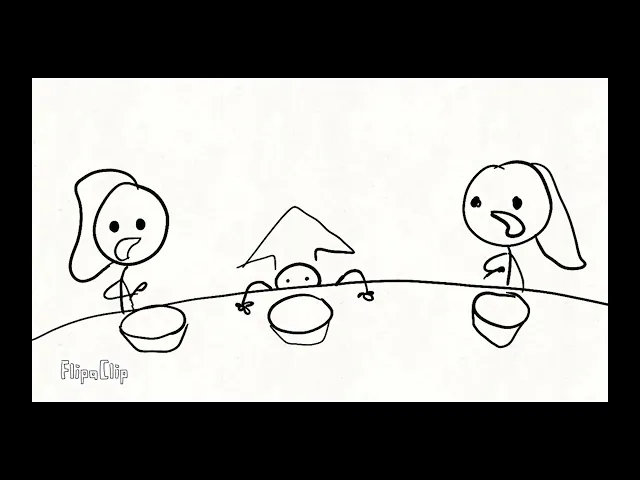
I made this with premiere pro, and flip-a-clip, and a bit of blender animation. I drew some of the shots in ms paint, and flip-a-clip then put them into premiere pro.
I made this with premiere pro, and flip-a-clip, and a bit of blender animation. I drew some of the shots in ms paint, and flip-a-clip then put them into premiere pro.
Defining the Film's Visual Style
Defining the Film's Visual Style
After finishing the core story, I needed a visual identity to the film. I've always wanted a retro themed project for some time; So when I got this opportunity, I jumped right in and centered this project around the retro games, early 2000's aesthetics I grew up playing. (Also, low poly, retro style saved me a lot of time).
This task of finding retro examples was not hard because I already had in mind what style I was going to emulate. I pulled from my DS games I used to play: Super Mario 64, and Dragon Quest Monster Joker, both 3D open world games.
Other examples I pulled from were Playstation 1 & 2 games: Crash Bandacoot, Spyro the dragon, God of War (original trilogy)
Let's get retro
Let's get retro
Super Mario 64 (DS)
Super Mario 64 (DS)


Dragon Quest Monster: Joker
Dragon Quest Monster: Joker


God of War
God of War


Spyro the Dragon
Spyro the Dragon


Crash Bandacoot
Crash Bandacoot


The Reason
The Reason
As you can see from these examples, a lot of these games look blocky, sharp, and rough around the edges. Smooth surfaces, or detailed shapes are rarely present and instead, replaced with simple geometry, colors, and textures.
You can also see that there's a pixelation effect going on as well. Whether it's a deliberate visual style or game engine limitations at the time, it's apparent in most of the games.
Another thing I wanted to emulate was the vertex displacement, basically, games back then did not have the precise decimal point math we have today, so they relied on whole number based math. This creates the snapping effect that some games have. I will talk about this a bit further down in my animation break down.
Creating Ryan's world,
in chronological order
Creating Ryan's world,
in chronological order

I modeled Ryan first
Based the proportions, features on myself. Focusing on visual simplicity, and shapes
The facial features were tricky at first: I wanted a complex face rig that's embedded into Ryan's actual geometry, but opted for simple image planes. This saved me time, because I can move them, adjust them to my needs.
Ryan: he's like an extreme version of me. Always depressed, no motivation, lashes out at people. Very quiet, isolating, does not want to receive help unless he's forced to.
here's a character break down:

loop to show around the proportions.

Instagram showcase
Ryan's apartment.
Ryan's apartment.

The kitchen rough draft, apartment entry area
The kitchen rough draft, apartment entry area
The kitchen rough draft, apartment entry area

Living Room
Living Room
Living Room

Ryan' s Desk
Ryan' s Desk
Ryan' s Desk

Living Room, but textured plus more models.
Living Room, but textured plus more models.
Living Room, but textured plus more models.

Kitchen, textured and detailed.
Kitchen, textured and detailed.
Kitchen, textured and detailed.

Ryan's room
Ryan's room
Ryan's room
The layout was easy to do because I had already 3D modeled it in my head. Majority of the textures were sourced from Polyhaven, some of them was made from scratch by me.
The layout was easy to do because I had already 3D modeled it in my head. Majority of the textures were sourced from Polyhaven, some of them was made from scratch by me.

The Sisters
The Sisters
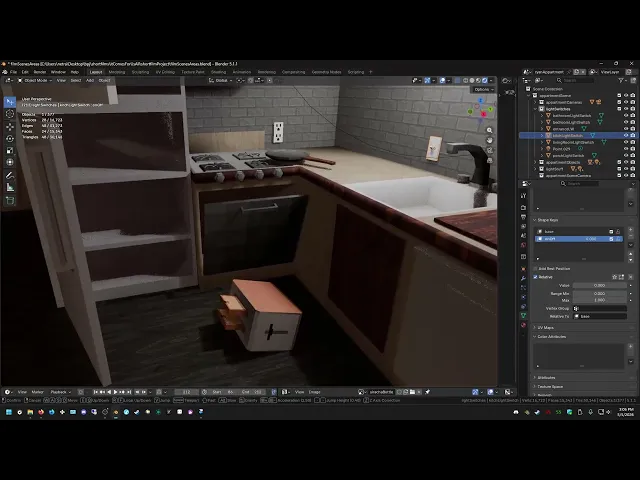
After modeling enough stuff in the apartment scene, I worked on making the sister characters. This was around mid February. I got a female character sheet from the internet and started blocking things out. Sure it's not perfect, but at least I got it done :).
After modeling enough stuff in the apartment scene, I worked on making the sister characters. This was around mid February. I got a female character sheet from the internet and started blocking things out. Sure it's not perfect, but at least I got it done :).

First Mesh

finished texturing

Sandra's WIP

Erin's early WIP

Sandra's showcase

Erin's showcase
First Mesh
Sandra's WIP
Sandra's showcase
finished texturing
Erin's early WIP
Erin's showcase
First Mesh
finished texturing
Sandra's WIP
Erin's early WIP
Sandra's showcase
Erin's showcase
Explanation behind the designs:
I based these two sisters on my own, so shout outs to them :).
I thought about what they represent, and what color they embody.
For Sandra: she's reserved, but she also compassionate. So I designed her around the neutral colors, grays blacks, whites, with an accent of blues. Because blues are typically associated with calm, chill, and stability.
as for Erin: she is outgoing and bright. She's a initiator, and is not afraid to take charge. I wanted her design color to reflect yellows for optimism, happiness, and positivity. Reds / pinks, for strength and compassion.
story wise: I needed the sisters to act as the support group for Ryan. They are figures that represent that positive help that you need during times of crisis. Them caring about their brother is what saves him from doing something stupid / impulsive.
below is a little video of me showcasing how I made the characters.
Hospital
Hospital
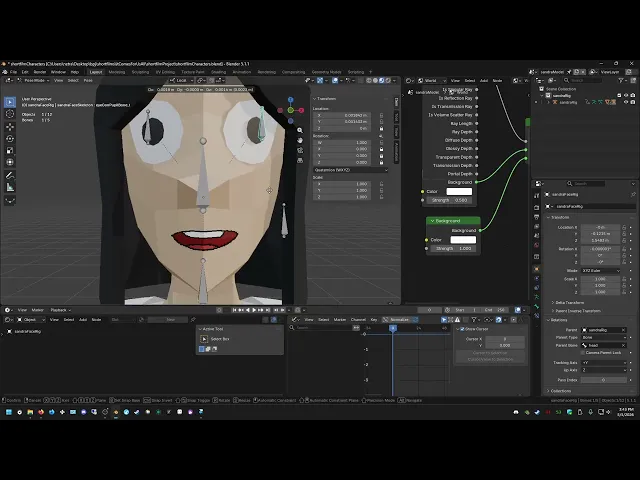
Looking at my outline: I saw that it was time to start working on the hospital scene. I looked up a hospital picture, and got this one for the hospital of Massachusetts.
So I went to work, blocking things out, positioning the camera like the one in the photo, trying my best to accurately mimic the shape of the hospital, when I had the sudden urge to delete it.
so I did.
I scrapped it and remade a hospital from scratch. Taking examples from a hospital in NYC.

block out of the Massachusetts general hospital.

hospital reference

outside hospital #2

hospital #2 parking lot with a car I made.

block out of the Massachusetts general hospital.
hospital reference
outside hospital #2
hospital #2 parking lot with a car I made.
block out of the Massachusetts general hospital.
hospital reference
outside hospital #2
hospital #2 parking lot with a car I made.
Video explaining my process
Video explaining my process
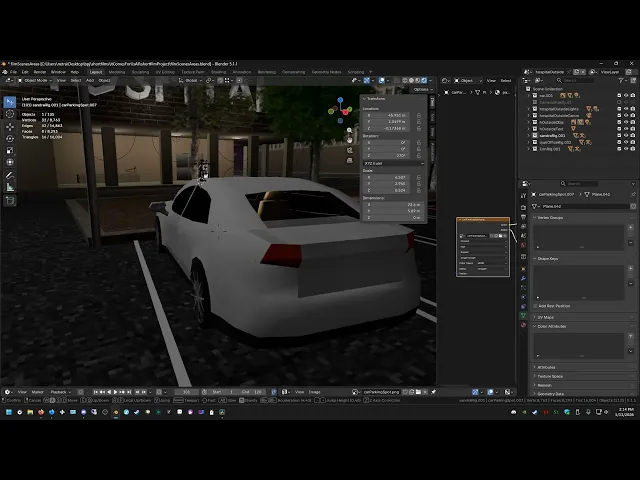
Apartment Street
Apartment Street


Office
Office


Office Reference
Office Reference
Office Reference


Hospital Interior
Hospital Interior


Young Ryan
Young Ryan

My motivation for making this younger version was for a completely different, original dream sequence. I simplified that scene to the scene in the film, a white void, self reflection scene.
In this original dream scene,
My motivation for making this younger version was for a completely different, original dream sequence. I simplified that scene to the scene in the film, a white void, self reflection scene.
In this original dream scene,
Ryan goes to sleep, and he wakes up in a familiar bed, his younger self's bed. He looks at his hands and its his younger self's hand. Unsure of what to feel, he absorbs his surroundings, he takes in as much as he can of this strange event.
He looks around his old room, thinking back to how he got the stuff around his room, when he notices the Nintendo DS on his night stand. He picks it up and pauses for a bit looking at the pink game console, a feeling of warm assurance washes over him. When all of a sudden, he hears a familiar voice, a voice that he has not heard in years: it calls him to come down to eat.
After hearing that voice, he lifts his head in a bit of realization. He puts the DS down gently, gets out of bed and slowly marches outside his room to the hall. The familiar voice once again calls Ryan's name.
The shot changes to the side of a staircase, The familiar voice calls Ryan one more time, and the camera sees Ryan cautiously walking down the stairs. The shot gets closer to Ryan, locking to Ryan's face, when the familiar voice joyfully says "There you are… I've been calling for you Ryan". The scene cuts again to a shot of Ryan's family sitting around the dining room table, with Ryan's mom in the center.
Ryan goes to join them, he eats good, then his mom tells him to brush his teeth and get ready for school.
He goes back up stairs, brushes his teeth, finishes and announces "Ok… I'm done now". There's a slight pause, he then says "mom?" with a questioning tone. No answer, he grabs his book bag and goes down stairs. He says "Dad?", walks into the living room and says "Sandra?", checks the kitchen and says "Erin?". He then says "guys?" a feeling of concern/defeat washes over him.
Camera moves to a wide shot of Ryan in the kitchen, it stays with him a bit. Ryan drops his bag in defeat, says nothing. Lights flicker, a ringing / tinnitus, high pitch noise slowly grows in volume to fill up the silence. A recognizable sound fade into the scene, the sound of a phone alarm humming. He looks at the coffee table where the phone sits, it shows the phone slightly moving due to the vibration. It cuts back to Ryan's defeated neutral face because he knows what it is, and it match cuts to present Ryan the next day.
Conceptually:
I needed this scene to be a visual representation about the mental struggles one may feel, especially during times of grief and depression. The inner battles you may have with yourself. The struggle to accept, to reconcile and to eventually move on. I wanted this to communicate the notion that, to ultimately move on, you NEED to resolve whats doing on inside.


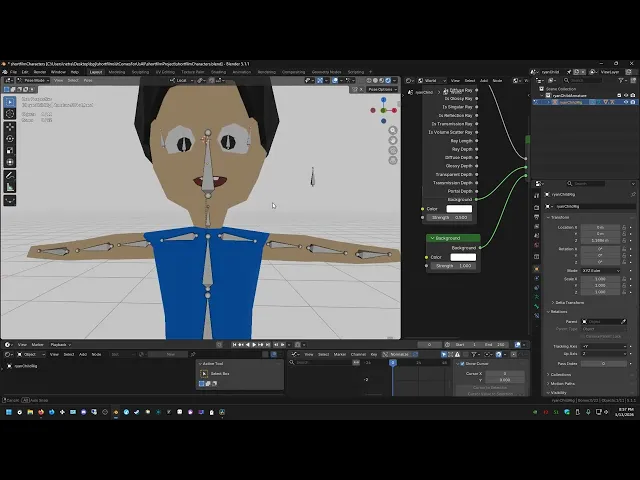
Ryan's Dad
Ryan's Dad

Ryan's dad story wise acted as Ryan's anchor, a person he relied on to stay grounded. When he's sad he seeks help from his dad, but what if he's taken away. What happens
Ryan's dad story wise acted as Ryan's anchor, a person he relied on to stay grounded. When he's sad he seeks help from his dad, but what if he's taken away. What happens
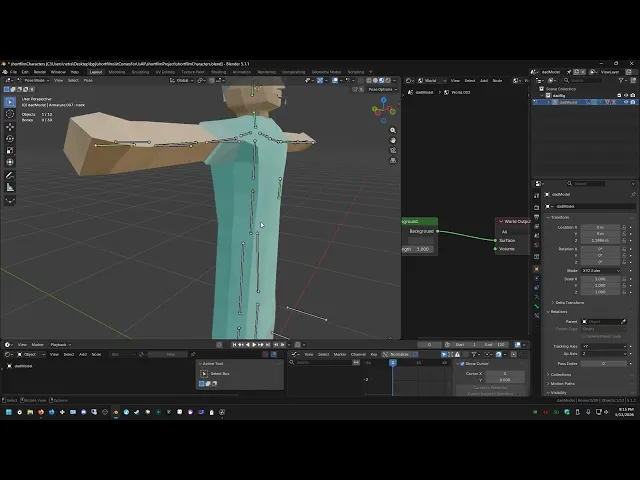
Hallucination Forest
Hallucination Forest
This scene was born from the "Ryan hallucinating his parents when he smokes" It was more complicated in that, I was going to animate Ryan running through a forest to find his parents, when he's suddenly comes across a mote of water (the railing of his apartment porch). His drugged up mind, influenced by his inner thoughts and wishes to see his parents again, almost made him jump across that water mote (jumping off the railing) until he was saved by his sisters who caught him in time.
The scene was altered because I needed to simplify things, and to also give the sisters more screen time, and develop their dynamic. The aftermath this situation was going to lead to the film's end as well. Once Ryan had been saved, he and his sisters start crying and the camera moves backwards and the film fades to dark with a warm glow around the trio to signal "in a dark sea of despair, the light of a familiar love guides you home" kind of message.


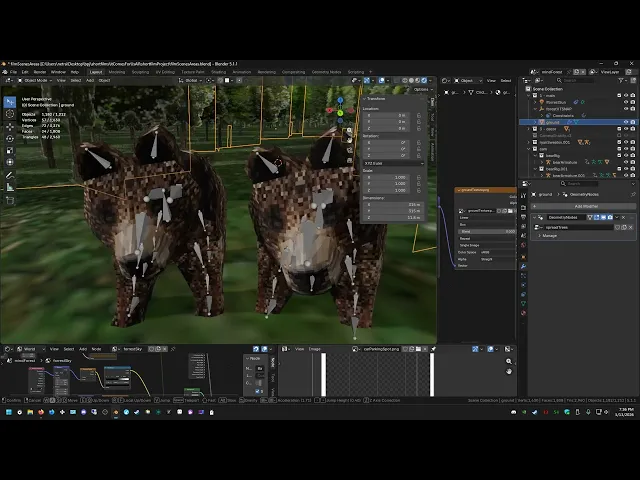
The Resturant
The Resturant
The ramen scene was a later / alternative ending to how I wanted it to end. Originally this ramen scene was supposed to be scene that took place after Ryan's dad passing away, but one of my volunteers suggested that I moved / delete it because it did not fit the tone appropriately. She was right, as it would have felt off to immediately go out to dinner after your parent just died. In the end, the scene was reworked and moved towards the end to serve a new purpose. Ease the built up tension, and resolve the third act.
It's a moment that communicates, acceptance, change and Ryan moving on.
He is still devastated by the loss of his father but at the same time, he has his sisters who support him and care for him. I wanted this to also convey that the smallest interactions like getting ramen is still a fulfilling one. You don't have to isolate yourself while experiencing grief and depression, its good to reach out to people, even if you feel uncomfortable.


Extra Additions
Extra Additions
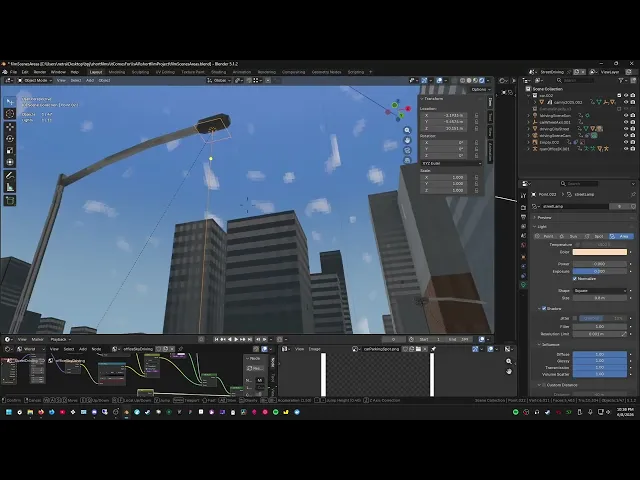
a Dynamic sky system
A very useful technique I figured out to visibly change the environment depending on the sun's rotation.
I took the light object, in this case its a sun. I used the light's object rotation property and apply it to the world shader I have. This allows me to influence the sky color, when to show stars, and thickness of fog.


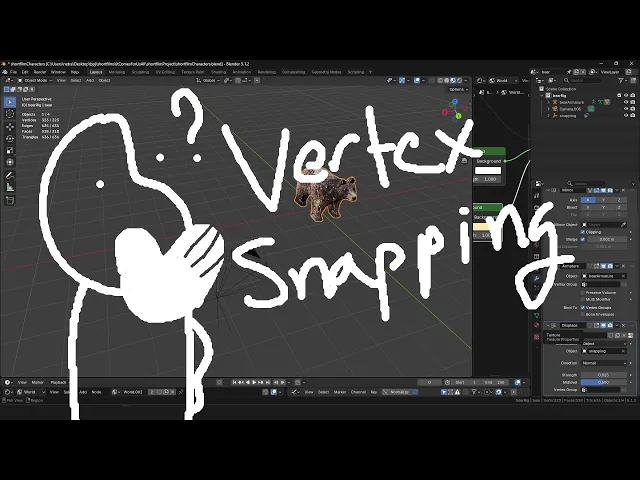
Vertex Snapping: Emulating old games
to achieve this, I used Blender's displacement modifier, a cell noise texture, and object trickery.
Vertex Snapping: Emulating old games
to achieve this, I used Blender's displacement modifier, a cell noise texture, and object trickery.

Toyota Camry
Toyota Camry
Added this car to have shots of Ryan driving home.
took a 2024 Camry, blocked it out, smoothed it and textured it. The doors and the wheels are separate objects, the trunk can be opened, and there are configurable head lights that an be turned off and on.
Added this car to have shots of Ryan driving home.
took a 2024 Camry, blocked it out, smoothed it and textured it. The doors and the wheels are separate objects, the trunk can be opened, and there are configurable head lights that an be turned off and on.

Recording the Voice Lines
Recording the Voice Lines
Recording the Voice Lines
At first, I wanted this film to be silent, only communicating through movements. Realizing that I kinda need voices, I started assembling the voice recordings. I originally wanted someone else to do Ryan's voice but I felt that it was only right to voice him myself. The dad, the not visible doctor, boss, and two sisters were all voiced by my friends.
I had another friend be the understudy / sample voice for the sisters. My plan was to give these example voices to the actors I chose but I scrapped that and let my friends voice the lines naturally, live. It turned out genuinely good, for what they were given. I personally did not have a high standard for how I wanted the voices to sound, I just picked the one that sounded good. My goal really was to allow my friends to feel comfortable and do the best they could.
The sister conversation was recorded live, along side my other friend who did the dad's voice. Funny enough, during the recording for, he started transitioning into a Russian accent. You can kind of hear it in the film if you listen closely.
The Ryan dream sequence was me recording lines through my IPhone, and transferring them to my laptop. The doctor's line was made up on the spot, I asked a friend during a study group if he wanted to do some lines. I just needed someone to announce Ryan's dad's condition. My friend who did the boss's voice was someone who I play games with, and I asked them to do the voice because he had that tone in him.
Before any lines were said, I made sure to explain a little about the character's background and emotional state. This helped a lot in terms of dialing in the specific tone I wanted. I took the recordings, tweaked them, cleaned them up in Audacity, and then put them into the editor.
At first, I wanted this film to be silent, only communicating through movements. Realizing that I kinda need voices, I started assembling the voice recordings. I originally wanted someone else to do Ryan's voice but I felt that it was only right to voice him myself. The dad, the not visible doctor, boss, and two sisters were all voiced by my friends.
I had another friend be the understudy / sample voice for the sisters. My plan was to give these example voices to the actors I chose but I scrapped that and let my friends voice the lines naturally, live. It turned out genuinely good, for what they were given. I personally did not have a high standard for how I wanted the voices to sound, I just picked the good ones out of the bunch. My goal really was to allow my friends to feel comfortable and do the best they could. Looking back now, I'm so proud..
The sister conversation was recorded live, along side my other friend who did the dad's voice. Funny enough, during the recording for, he started transitioning into a Russian accent. You can slightly hear it in the film if you listen closely.
The Ryan dream sequence was me recording lines through my IPhone, and transferring them to my laptop. The doctor's line was made up on the spot, I asked a friend during a study group if he wanted to do some lines. I told them, I just needed someone to announce Ryan's dad's condition and he agreed - so he did them on the spot.. My friend who did the boss's voice was someone who I play games with, and I asked them to do the voice because he had that tone in him.

Post Production Workflow
Post Production Workflow
Workflow for my short film:
Step 1 - I gather all of my audio recordings
Step 2 - I animate in Blender using its sequence window to sync audio to time. This allows me to sync actions as well.
Step 3 - Once I am done animating, I render out the scene without audio, then put it into Premiere Pro.
I would repeat, step 3 for each shot and for every scene until I was done. Occasionally, a random idea would pop into my head and I'd just do that scene / idea on the spot.
Step 4 - Assemble in the editing program.
Step 5 - I add music, sound effects and do the sound design.
The main downside of this workflow was that each shot was done once, the good thing was that I knew what I wanted going into each shot. This saving me a lot of time in the end.


Tools & Resouces
Tools & Resouces
These are all the tools and resources I used.
For 3D, it's Blender: I did most of the work in there. The animation, the texturing, and compositing in here.
there is a plugin that I used that allowed me to have shaky camera, Camera Shakify, saving me tons of time of possible manual tweaking.
For graphic work, I used Photoshop and Aseprite.
I used Photoshop to mainly flatten textures I got from Google Maps. For Aseprite, I used this to make pixel textures and compress regular textures. Both were generally used to tweak media if need be.
For sound resources, I used the site Pixabay, and Freesounds.org. Occasionally I would get some from YouTube. YouTube was also a place for me to learn different techniques that I put into the film.

Editing & Flow
Editing & Flow
The editing style is very linear, there's no flash backs, just one continuous story. Like time, its a continuous thing, so I wanted to emphasize that in the editing as well. You can't go back, you just have to keep moving forward.
This style of editing wasn't anything new but at the same time: it was, It was slower paced, more structured, and told an actual story. My editing tool kit consisted of L used J cuts, fades/dissolves, jump cuts, and a lot of hard cuts. Consciously, I forgot some of the names, but at the same time, I knew what kind of cut I wanted to have in the moment.
Another thing that I learned as I did this project was camera movement and positioning. I learned a ton about framing, and what constitute good visual communication. It was good that I had taken a Photography and visual literacy class because I applied a lot of what I learned form those classes into this project. The still shots that focused on Ryan sitting on the couch was to represent the emptiness he feels. A lot of the shots that were far a way from him was also about him distancing himself. The trucking shot into a match cut of him in the forest was a cool way I saying: we are entering his world. Basically, a lot of the shots, framing and camera movements were stuff I thought would be cool conceptually.
Sound design

I got the sounds from Freesounds and Pixabay
I'd pick the sounds from the websites, pick some other similar ones, and if it didn't have what I wanted: I just made the sound from scratch. The main problem with recording my own stuff was the noise: I tried my best to mitigate the noise, but some slipped through the filter / effect cracks.
Speaking of effects, I mainly used the deNoise effect if an audio was too noisy: this was included in Premiere Pro but sometimes I would occasionally edit an audio inside Audacity. Render it and put it back into Premiere Pro.
Final Tweaks & Distribution
Final Tweaks & Distribution
I rendered out a version without the music for YouTube, in case I got struck down, but it turned out to be useless because the music played too much of a vital role in setting the overall mood in the scenes they were in. Ultimately, I did upload a music-less version on my channel, if the inevitable did come true.
Outside of posting the full movie onto YouTube: I made short vertical clips, then posted it to YouTube Shorts, TikTok, Instagram and Twitter. I additionally did "promotional" showcases on my Instagram, posting my characters, and snippets.
A lot of the views were from my own friends, but about 50-60% were from algorithm reach as well.

Evaluation
By the time I finished the project, it was the week before senior presentations. I had a plan to do some additional research, so what I did was ask my viewers to do a little post viewing survey. I asked them these simple questions to assess the quality, see what their mood was, and to see if they resonated with the film message.
What they throught about the film,
What they thought I missed,
What I could have added,
and If they were me: what they could have added.
Most said they loved the idea and appreciated the film, they said I could have added a bit more characters, dialog, one specifically: fixed the audio (yeah…). Overall, it received higher praise than I expected and I appreciate my viewer's honesty and input.

Finally, What I learned.
Finally, What I learned.

I grew more confident about my skills, learned what I am capable of and discovered places I am deficient in. If I had a longer time to freely execute my ideas, I may have increased the quality significantly I believe. I discovered that I can adapt fairly quickly and come up with solutions on the spot.
I also learned how to write a lot better, do animation, graphics, editing etc… which is nice.
I quickly want to shout out my teacher and mentor that helped facilitate this project: Mrs. Franzini. She helped me a lot directing my focus and keeping me on track in both phases of this project. I also want to shout out to my friends who helped voice act my characters, It would have been annoying hearing my voice for all the characters.
And to you - dear reader, thank you for being patient :)

